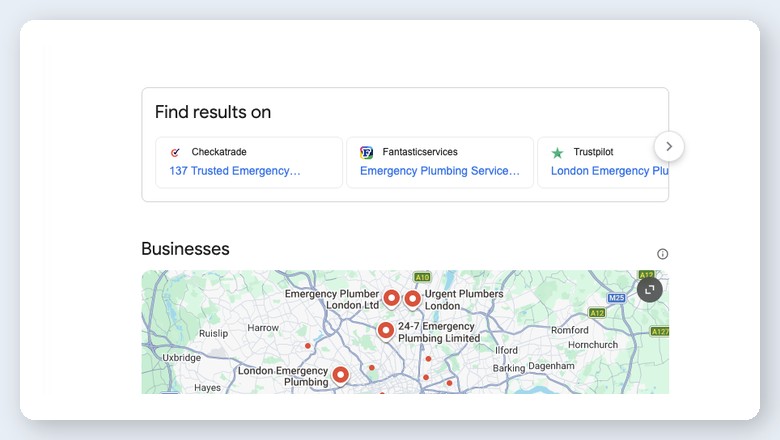
Google's local search results in Europe look meaningfully different from those in the United States — and they've continued to evolve as regulatory pressure on Big Tech has intensified. For businesses targeting customers in EU markets or the UK, understanding how these differences work is essential to building an effective local SEO strategy.
How It Started: The 2020 Find Results Carousel
In February 2020, Google began rolling out a significant change to local search results across the European Union: a "find results on" carousel appearing above the traditional map pack. This row of branded directory buttons — linking to platforms like Yelp, TripAdvisor, Yell, and sector-specific directories — gave third-party sites prominent placement above Google's own Maps listings.
The change was Google's response to mounting EU antitrust pressure. Following a €1.49 billion fine for anti-competitive practices in advertising, and sustained lobbying from platforms arguing that Google self-preferenced its own local content, the carousel was introduced to surface rival directories more prominently in European search results.
The Digital Markets Act Changes Everything (2023–2024)
The find results carousel was just the beginning. The EU's Digital Markets Act (DMA), which came into force in March 2024 and applies to Google as a designated "gatekeeper," introduced far more sweeping obligations. Under the DMA, Google is required to give third-party services equal, non-discriminatory treatment in search results. This has accelerated and deepened the changes to local SERPs in EU member states.
In practice, this means:
- Competing vertical search services — including local directories, comparison platforms, and booking tools — must be displayed in a way that doesn't disadvantage them relative to Google's own equivalent services
- Google Maps and Google Business Profile results cannot be systematically elevated above equivalent third-party content simply because they are Google products
- Transparency requirements mean Google must disclose how it ranks local results and what factors influence the local pack
The result is that EU local SERPs now routinely feature directory carousels, comparison site links, and booking platform buttons alongside (and in some cases above) the traditional map pack. The specific layout varies by query, category, and country — and continues to evolve as Google implements DMA compliance iteratively.
| Feature | EU (DMA Markets) | UK (Post-Brexit) |
|---|---|---|
| Directory carousel | Prominently displayed above map pack on most local queries | Less consistently present; shown on some queries |
| Map pack placement | Often pushed below third-party directory links | Retains traditional prominent placement |
| Regulatory driver | Digital Markets Act (March 2024) | DMCC Act (2024) — enforcement still ramping up |
| Comparison site visibility | High — required by DMA non-discrimination rules | Moderate — expected to increase with CMA action |
| Impact on citation strategy | Critical — directories appear in carousel | Important — and growing as regulation tightens |
The UK: A Different Path Post-Brexit
The UK left the EU and is no longer subject to the Digital Markets Act. However, the UK is not without regulatory pressure on Google. The UK's Competition and Markets Authority (CMA) has conducted its own investigations into Google's dominance in search and local search, and the UK's Digital Markets, Competition and Consumers Act (DMCC Act, 2024) gives the CMA new powers to regulate designated "Strategic Market Status" firms — including Google.
In practice, Google UK search results currently retain a more traditional local pack layout than EU markets. The find results carousel is less consistently present on google.co.uk than on Google's EU country domains. However, UK businesses should not assume this gap will persist: CMA enforcement under the DMCC Act is expected to drive changes to Google's UK behaviour over the coming years.
Regardless of the regulatory picture, the underlying strategic implication is the same on both sides of the Channel: strong directory presence is not optional.
Is your business visible in Europe's local search results?
Directory listings are now a first-class SERP feature across the EU and UK. Make sure your business appears where customers are looking.
Explore citation building packages →What This Means for Your Local SEO Strategy
Whether you're targeting customers in the EU or the UK, the regulatory environment has reinforced what was already true from an SEO perspective: third-party directories are now a first-class element of the local search landscape, not an afterthought.
The directories most likely to appear in EU carousels and UK local results include:
- Yelp and Yelp-powered platforms
- Yell (UK), Pages Jaunes (France), Gelbe Seiten (Germany)
- TripAdvisor (hospitality and leisure)
- Trustpilot and Google-verified review platforms
- Houzz (home improvement)
- Checkatrade, MyBuilder, and Rated People (UK trades)
- Sector-specific directories relevant to your industry
If your business isn't listed on these platforms — or is listed with inconsistent NAP data — you're invisible in prominent new SERP features that your competitors may already be appearing in.
Key Takeaway
EU regulations have turned directory listings from a "nice to have" into a primary SERP feature. Businesses without accurate, consistent citations on platforms like Yelp, TripAdvisor, and country-specific directories are missing out on visibility that Google is now required to provide to third-party services.
NAP Consistency Across EU and UK Markets
For businesses operating across both the EU and the UK (or multiple EU countries), citation consistency becomes more complex. Country-specific formatting conventions for phone numbers, addresses, and business registration details must be correct for each market. A UK phone number format used in a French directory, for example, can create NAP inconsistencies that suppress local rankings.
The solution is the same as in any market: maintain consistent, accurate, and complete listings across every relevant directory in each country you operate in — with formatting tailored to local conventions.
Multi-Market NAP Tip
When listing your business across multiple European markets, always localise your phone number format (e.g. +44 for UK, +33 for France, +49 for Germany) and use the correct address conventions for each country. A single formatting inconsistency can suppress your rankings in that market's local results.
Get Your Business Listed Across the Directories That Matter
Our citation building service gets your business listed accurately across hundreds of relevant UK and EU directories — including those most likely to appear in Google's local results.
View Citation Building Packages