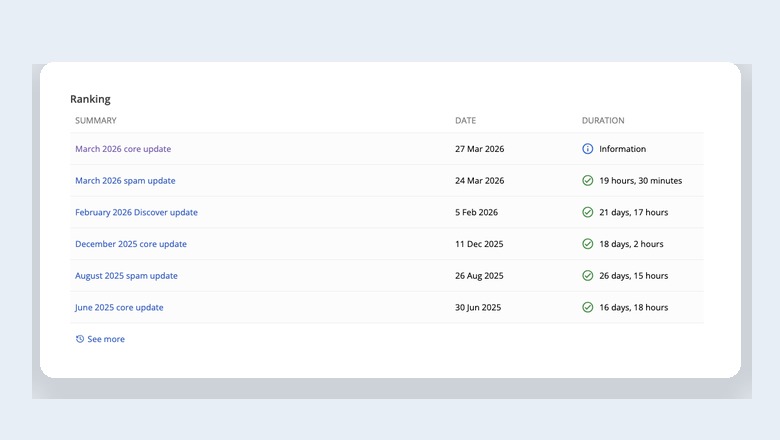
Google has done something unusual this week: it released two separate algorithm updates within three days of each other. The March 2026 spam update launched on Monday 24 March and finished rolling out in a record 19 hours and 30 minutes. Then on Thursday 27 March, Google announced the March 2026 core update, which is expected to take up to two weeks to fully roll out.
Two algorithm updates in the same week is rare. It means site owners are dealing with overlapping changes to both spam enforcement and content quality assessment at the same time. Here is what each update does, how they differ, and what you should be checking on your site right now.
The March 2026 Spam Update
Google confirmed the March 2026 spam update on 24 March. Unlike most spam updates, which typically take several days to complete, this one finished rolling out in just 19 hours and 30 minutes. That makes it the fastest spam update Google has ever deployed.
The spam update is powered by SpamBrain, Google's AI-based spam detection system. SpamBrain analyses sites and links to identify content that violates Google's spam policies. These policies cover a range of manipulative practices including automatically generated content designed to manipulate rankings, cloaking, hidden text, scraped content, and other deceptive techniques.
One important detail: this spam update did not specifically target link spam or site reputation abuse. Google has run separate updates for those in the past. This update focused broadly on sites violating existing spam policies. No new spam policies were introduced alongside the update either, meaning the rules have not changed — Google is simply getting better at enforcing the ones already in place.
What happens if you're hit by a spam update
Sites affected by a spam update typically see sharp, sudden drops in rankings. Unlike core update fluctuations, which can be gradual, spam enforcement tends to be binary: either your site is flagged as violating policy or it is not. If your rankings dropped significantly between 24 and 25 March, the spam update is the likely cause.
Recovery from a spam update requires identifying and fixing the specific policy violations, then waiting for a future spam update or submitting a reconsideration request if you have received a manual action in Search Console.
The March 2026 Core Update
Three days after the spam update completed, Google announced the March 2026 core update on 27 March. Core updates are fundamentally different from spam updates. Google described this one in its typical language: a regular update designed to better surface relevant, satisfying content from across the web.
Core updates reassess how Google evaluates content quality. They do not penalise sites for breaking rules. Instead, they change the relative weighting Google gives to different quality signals. A site that was ranking well might drop after a core update — not because it did anything wrong, but because Google now considers other content to be more relevant or more helpful for those queries.
This core update is expected to take up to two weeks to roll out fully. During that period, you may see fluctuations in rankings as Google reprocesses its index with the new quality signals.
Spam Update vs Core Update: What's the Difference?
The distinction between spam updates and core updates is important because the cause of any ranking change — and the appropriate response — depends entirely on which type of update is responsible.
| Spam Update | Core Update | |
|---|---|---|
| Purpose | Enforces Google's spam policies against sites using manipulative techniques | Reassesses content quality to surface more relevant, satisfying results |
| Technology | SpamBrain AI-based spam detection | Broad quality signals across Google's ranking systems |
| Impact | Sharp, sudden ranking drops for affected sites | Gradual ranking shifts as the update rolls out over 1-2 weeks |
| Why rankings drop | Site violates a specific spam policy | Other content is now assessed as more relevant or higher quality |
| Recovery | Fix the spam policy violation, then wait for next spam update or request reconsideration | Improve content quality and E-E-A-T signals over time |
| Rollout speed | This one: 19.5 hours (record fast) | Typically 1-2 weeks |
What This Means for Your Website
Having two updates overlap makes it harder to diagnose ranking changes. If your site's rankings shifted this week, you need to determine whether the cause is the spam update, the core update, or both. Here is how to approach it:
- Check the timing of any drops. If your rankings fell between 24 and 25 March, the spam update is the most likely cause. If drops happen from 27 March onward over the next two weeks, the core update is more likely responsible.
- Review your content for spam policy violations. If you suspect the spam update hit your site, audit your content against Google's spam policies. Look for auto-generated content, hidden text, cloaking, keyword stuffing, or scraped content that may have slipped through.
- Focus on content quality for core update recovery. Core updates reward sites that demonstrate expertise, experience, authoritativeness, and trustworthiness (E-E-A-T). This means publishing original, well-researched content and building a strong brand authority across the web.
- Don't make drastic changes during rollout. The core update will take up to two weeks to finish. Making sweeping changes to your site while the update is still rolling out makes it impossible to measure the actual impact. Monitor first, then act once the rollout is confirmed complete.
- Strengthen your site's digital footprint. Both updates ultimately reward sites that are legitimate, well-established businesses. Consistent NAP data across directories, genuine reviews, and a verified business presence all contribute to the trust signals Google looks for.
Strengthen Your Site's Trust Signals
Accurate, consistent citations across high-authority directories help Google verify your business is legitimate. Our manual citation building creates that foundation.
View citation packages →How to Check If You're Affected
If you are concerned about either update, here are the practical steps to assess your situation:
- Check Google Search Console. Go to the Performance report and look at clicks and impressions over the past 7 days. Filter by specific pages or queries to identify where any drops have occurred. Pay attention to the dates: changes on 24-25 March point to the spam update, changes from 27 March onward to the core update.
- Review your analytics. Compare organic traffic this week to the previous week. Look for sudden drops (spam update) versus gradual declines (core update). Segment by landing page to identify which sections of your site are affected.
- Check for manual actions. In Search Console, go to Security & Manual Actions > Manual actions. If Google has flagged your site for a spam policy violation, this is where you will see it.
- Monitor over the next two weeks. The core update is still rolling out. A page that drops today may recover as the update completes. Conversely, pages that seem stable now may see changes later. Do not draw final conclusions until the rollout is confirmed finished.
Search Console Tip
Set a custom date range in the Performance report comparing 24-27 March to the previous week. This makes it much easier to spot which specific pages and queries were affected and when the changes started. You can also enable the "date" row in the table to see day-by-day breakdowns.
Two algorithm updates in one week is a lot to process, but the fundamentals have not changed. Sites that follow Google's guidelines, publish genuinely useful content, and maintain a clean, verifiable online presence will continue to perform well. If you have been doing things the right way, these updates should work in your favour over time.
Build a Stronger Digital Foundation
Consistent, accurate citations across hundreds of directories help establish the trust signals that Google's algorithm updates reward. Our manual citation building service does the work for you.
View Citation Building Packages